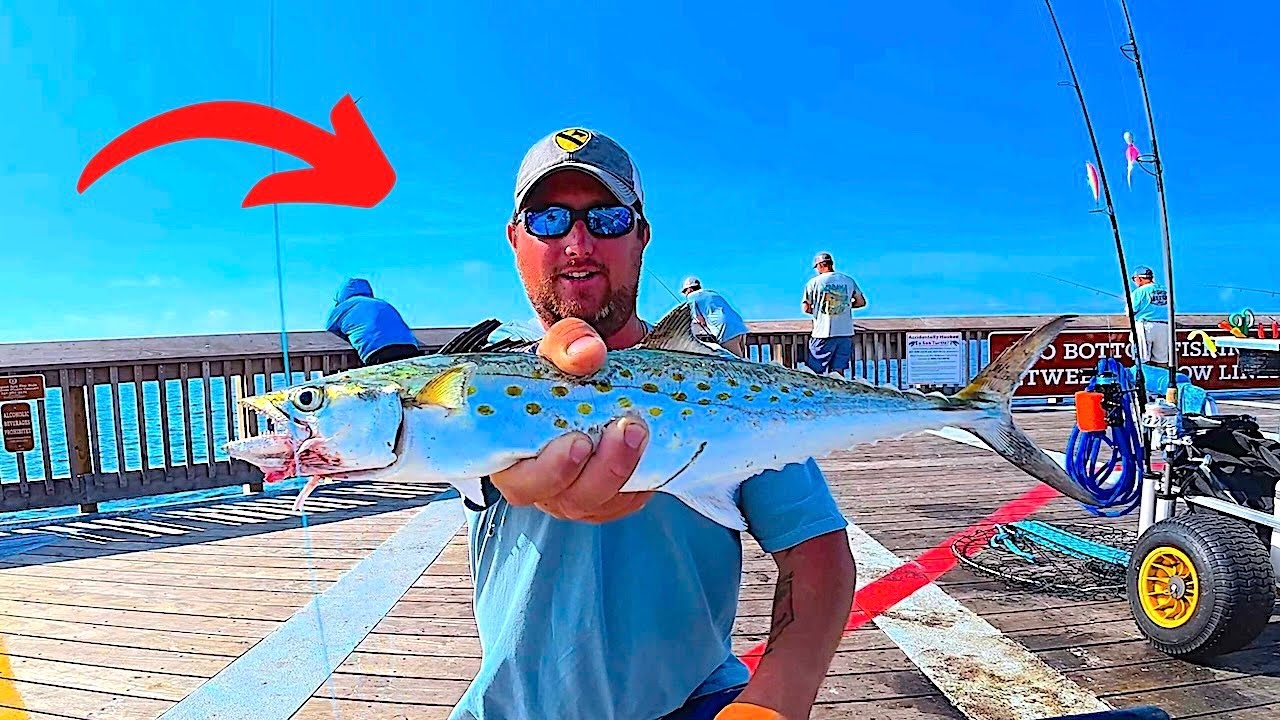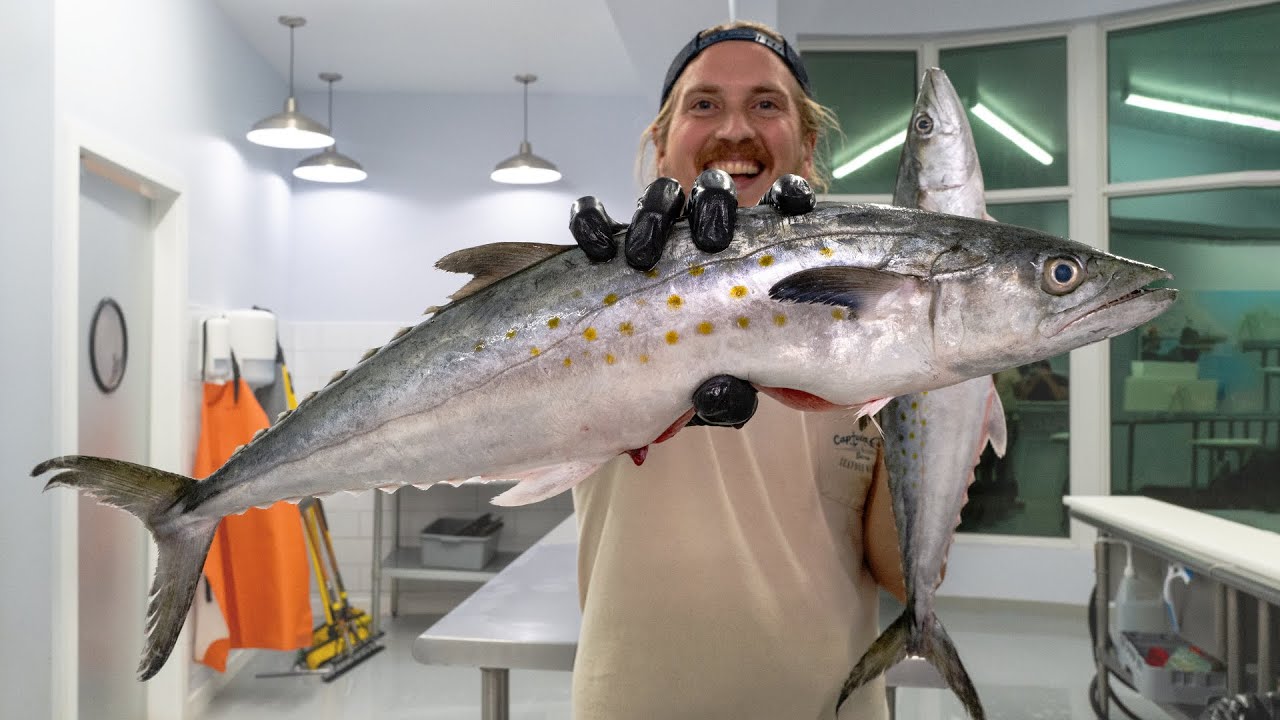
Spanish mackerel run the Sarasota coast twice a year: a spring push from March through May and a fall run in October and November, with the peak weeks in April and October. Find them in Big Sarasota Pass and New Pass on outgoing tides, along the beach within casting range of the sand, and over the nearshore reefs in 40–60 ft. Water temperature crossing 68°F is the trigger both directions.
When do Spanish mackerel run in Sarasota?
Two migrations, keyed to water temperature and bait. The spring run starts when the coastal gulf passes roughly 68°F in March; the fall run peaks in October as bait flushes out of the bay.
| Month | What to expect |
|---|---|
| January | Resident fish on Sarasota Bay’s deep grass flats in mild winters; conditions-dependent |
| February | Deep flats (Middleground, Radio Tower area) mixed with trout and bluefish |
| March | Spring run begins — schools arrive along beaches and nearshore reefs past ~68°F |
| April | Peak — passes, beaches, deep flats |
| May | Strong along beaches and coastal gulf; bait schools thick |
| June | Good nearshore over reefs and hard bottom |
| July | First light nearshore; heat compresses the bite to early morning |
| August | Deep flats with bluefish and pompano; kingfish start showing nearshore |
| September | Deep grass flats of Sarasota Bay; fall bait flush begins |
| October | Fall run peak — beaches, passes, nearshore reefs; birds on breaking fish |
| November | Fall run continues through the month most years |
| December | Coastal gulf in warm spells; deep-flat fish linger in mild winters |
Local guides report the same twin-peak pattern year after year — see the Visit Sarasota monthly fishing reports and Off the Hook’s Sarasota seasons guide.
Where can I catch Spanish mackerel in Sarasota?
- Big Sarasota Pass and New Pass — outgoing tide flushing bait into the gulf. Drift the channel edges and cast jigs. Same program that produces pompano on the bottom produces mackerel up top.
- Beaches — Lido, Siesta, Turtle Beach, Casey Key, Venice. Watch for diving terns and showering glass minnows; schools push bait within casting range of dry sand. More on beach access at Siesta Key.
- Nearshore reefs — the Sarasota County M-reef series, M-1 through M-9, sits 7–9 miles off Lido and Siesta in 40–60 ft. Official coordinates are on the Sarasota County artificial reef page; a full GPS list is at Florida Go Fishing’s Sarasota reef directory. Closer in, Silvertooth Reef (I1) sits in 30 ft, 1.8 nm off New Pass.
- Deep grass flats of Sarasota Bay — 8–12 ft over the Middleground and the flats off Bird Key and Long Bar. This is the winter and late-summer pattern.
- Venice jetties and the Venice Fishing Pier — the region’s most reliable shore access during the runs. Details at Venice Jetty fishing and the Venice Fishing Pier.
Clean, green water matters. The bite dies in red tide or heavy turbidity, and moving tide beats slack every time. Birds working = fish. Period.
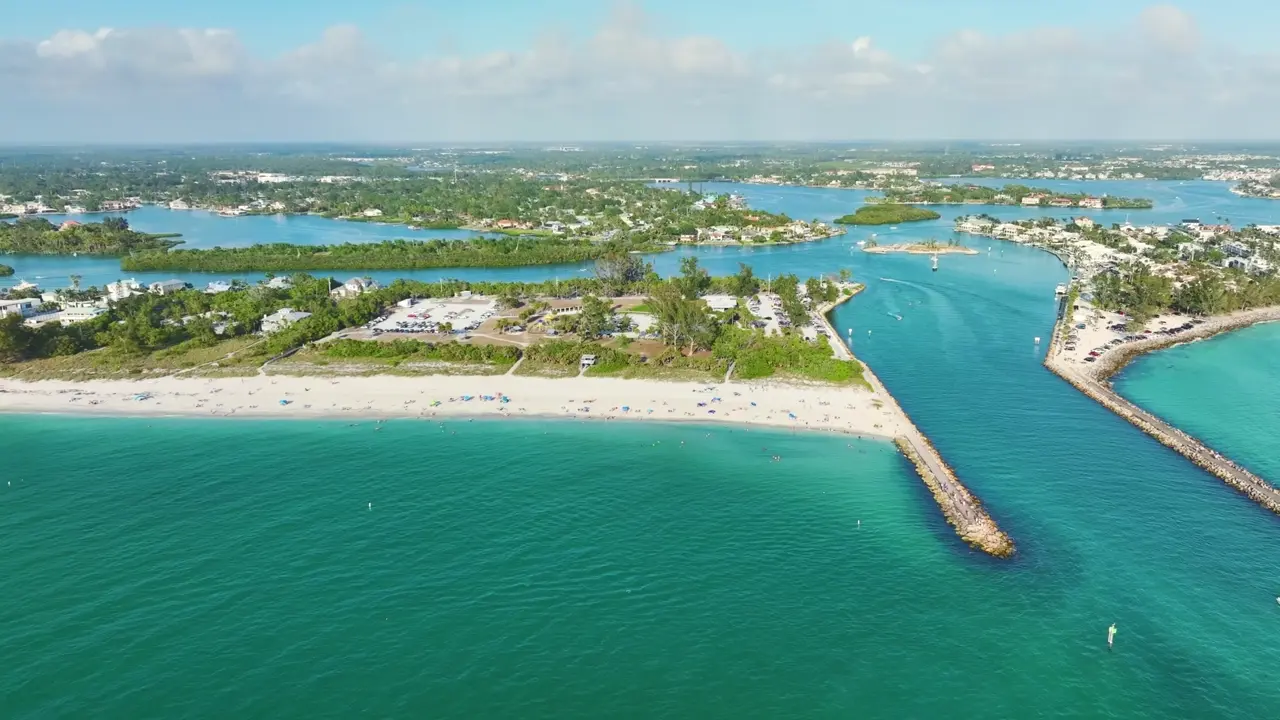
A jettied pass empties onto open sand — mackerel set up on that edge.
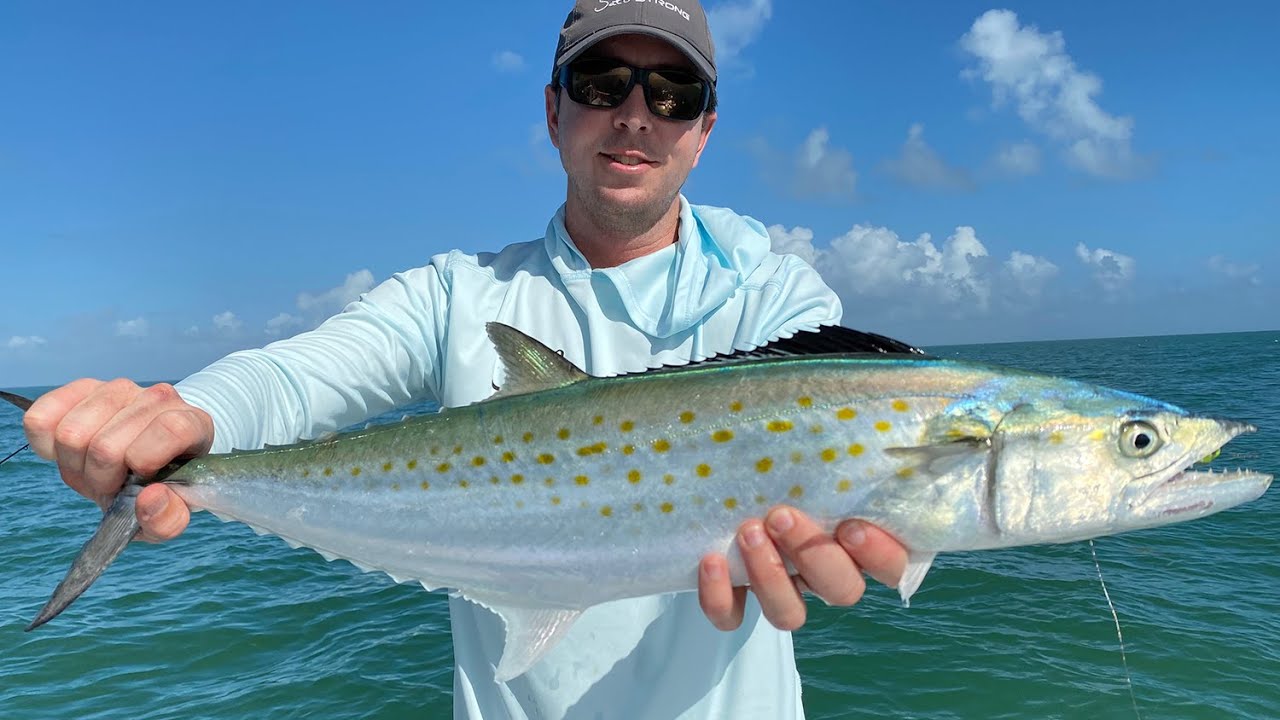
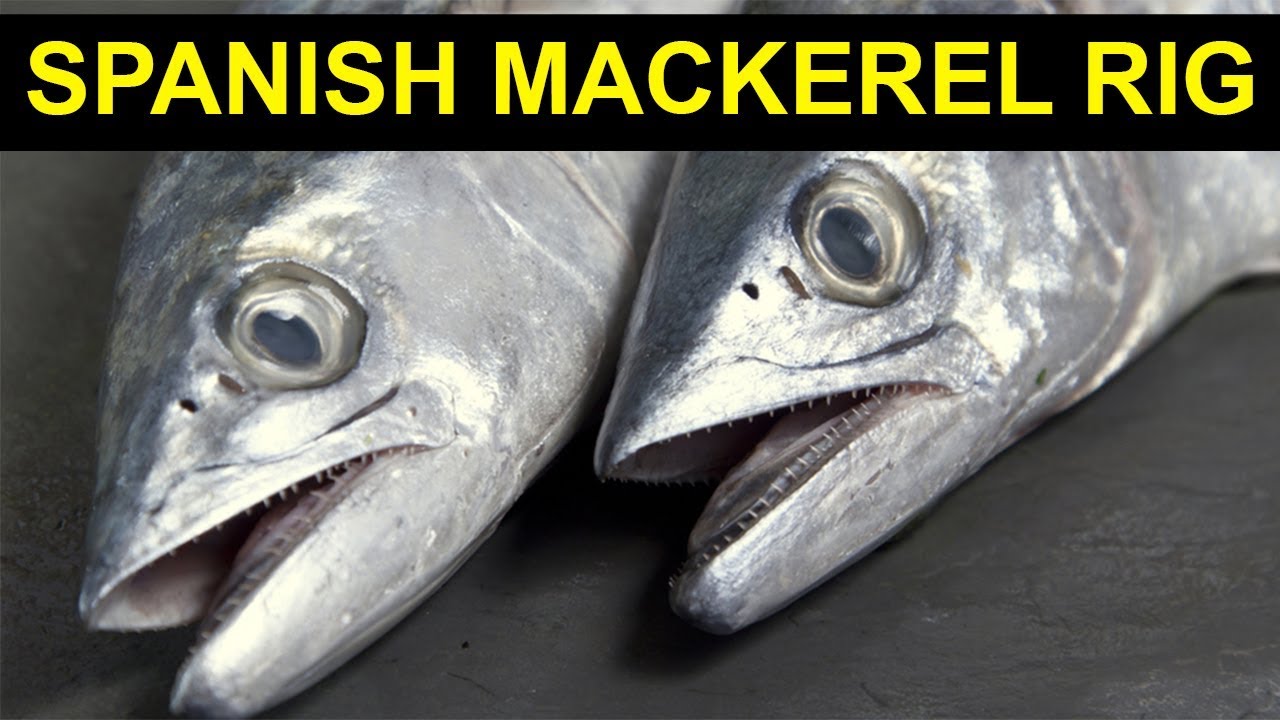
How do you tell a Spanish mackerel from a king mackerel?
Juvenile kings under about 10 lb carry spots too, and the two mix on the same reefs in fall — so check every fish against the 12” Spanish minimum and the separate king rules.
| Feature | Spanish mackerel | King mackerel |
|---|---|---|
| Lateral line | Slopes gradually toward the tail | Drops sharply below the second dorsal fin |
| First dorsal fin | Black patch on the front | No black patch |
| Typical size | 1–3 lb locally | 10 lb+ common nearshore |
The FWC Spanish mackerel species profile has comparison illustrations worth saving to your phone.
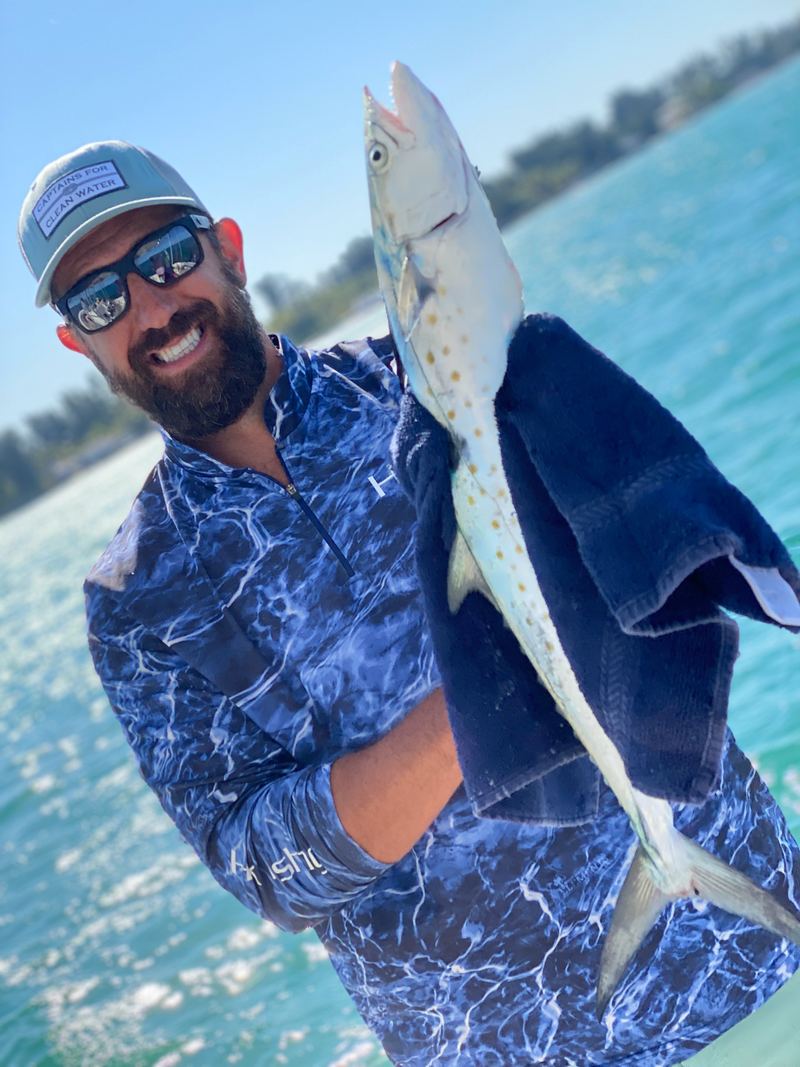
What’s the best lure and leader for Spanish mackerel?
Speed is the whole game. Fast, erratic retrieves get bit; slow retrieves get followed.
- Casting: 1/2 oz silver spoon (Clarkspoon), Gotcha plugs, or small white bucktail and soft-plastic jigs ripped fast. This is the beach and pass standard.
- Trolling: a #1 planer or a bare 00/0 Clarkspoon at 5–7 knots over the reefs and along beach contours covers water when fish aren’t showing.
- Live bait: scaled sardines or threadfins free-lined or under a cork over the deep flats. Chum with a few live “shakers” to bring the school to the boat — the core of local live bait fishing.
- Fly: white or chartreuse Clouser and glass-minnow patterns on an intermediate line, fast two-hand strip.
Leader: 30–40 lb fluorocarbon draws far more bites than wire. Accept the occasional cut-off — those razor teeth are why. Long-shank #1–1/0 hooks reduce bite-offs. Go to #2–#3 single-strand wire only when fish are thick and not leader-shy. Keep fingers clear at the net; the teeth are no joke.
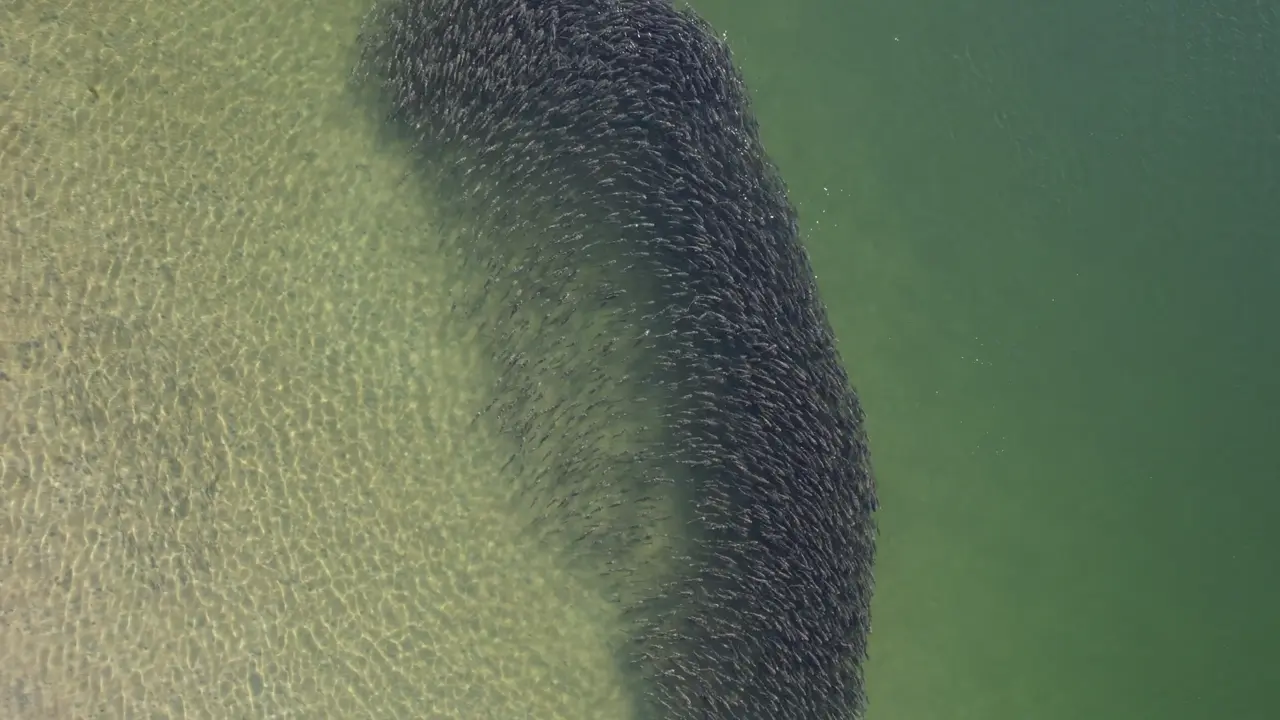
A bait school reads as a dark mass from the air — the mackerel are under it.
What are the 2026 Spanish mackerel regulations in Florida?
| Item | 2026 rule |
|---|---|
| Minimum size | 12” fork length |
| Bag limit | 15 per harvester per day |
| Season | Open year-round |
| Allowed gear | Hook and line, cast net, beach/haul seine, spear |
Source: FWC Spanish mackerel regulations. The same limits apply in Gulf and Atlantic state waters. A Florida saltwater license is required — residents fishing from shore qualify for the free shoreline license (FWC license info). Rules change; verify current regulations before you fish.
The Florida state record is 12.00 lb, caught at Fort Pierce on November 27, 1984 (Florida saltwater records). Any Sarasota fish over 5 lb is exceptional.
Are Spanish mackerel good to eat?
Yes — fresh. Bleed the fish immediately and get it on ice; the dark, oily meat degrades fast and freezes poorly. Eaten within a day or two, broiled or smoked, it’s excellent and loaded with omega-3s. Mercury content is moderate, so keep portions reasonable.
FAQ
When is the best month for Spanish mackerel in Sarasota? April and October. Both migration peaks put schools on the beaches, in Big Pass and New Pass, and over the M-reefs.
Can I catch Spanish mackerel from shore? Yes. The Venice jetties, Venice Fishing Pier, and any Sarasota beach with birds working within casting range. A silver spoon on a long cast covers it.
Do I need a wire leader? Usually no. 30–40 lb fluorocarbon out-fishes wire. Switch to light single-strand wire only when fish are thick and cut-offs outnumber bites.
What do Spanish mackerel eat? Scaled sardines (whitebait), threadfin herring, and glass minnows. Match the size — small, flashy, fast.
Is there a season closure? No. Spanish mackerel are open year-round in Florida with a 12” fork minimum and 15-fish bag.
Related reading
Chasing the same fall bait schools? Pompano run the passes on the bottom while mackerel work up top, tripletail load the stone crab buoys starting October 15, and cobia push down the coastal gulf on the same October window. In spring, mackerel schools along the beach often share water with tarpon and rolling bait — one nearshore trip can hit all of it inside 9 miles.